New Resident Nevada DMV Guide: Transfer Your License and Register Your Car in 30 Days
New Nevada residents have 30 days to get a Nevada driver’s license and register their vehicles. Most drivers 21 and older with a valid U.S. license can skip the tests, and you can handle the license and the registration in one DMV visit. Here’s the order to do it in.
Written by the DMV Appointment Las Vegas team · Verified by Ryan Parker & Ethan Miller · Last updated: November 2026
Pick your move-in date to see your 30-day deadline for both your license and your registration.
Book your appointment
Pick an office to open its official booking page. If your current license or registration expires before the appointment, print your confirmation email and keep it with you in case you’re stopped.
Book, view, reschedule or cancel
One appointment covers your license and your registration. Pick an office to open its booking page.
East Sahara DMV
2621 E. Sahara Ave., Las Vegas, NV 89104 · Mon–Fri 8–5, Sat 8–4
All official booking links
- East Sahara: general appointment · drive test
- West Flamingo: general appointment · drive test
- North Decatur: general appointment · drive test
- Silverado Ranch: general appointment · drive test
- Silverado CDL building: CDL line or knowledge test
- All offices on dmv.nv.gov
When do you count as a Nevada resident?
The 30-day clock starts when you become a resident. Under Nevada law you’re a resident if Nevada is your legal residence, you live here and work or run a business here, you use Nevada as the home state for your vehicles, or you claim Nevada residency to get state benefits.
Some people don’t have to switch: active-duty military members and their spouses or dependents, out-of-state students, and people living in Nevada temporarily. Tourists and seasonal residents aren’t residents either. You’ll need a Nevada street address for your license; P.O. boxes aren’t accepted.
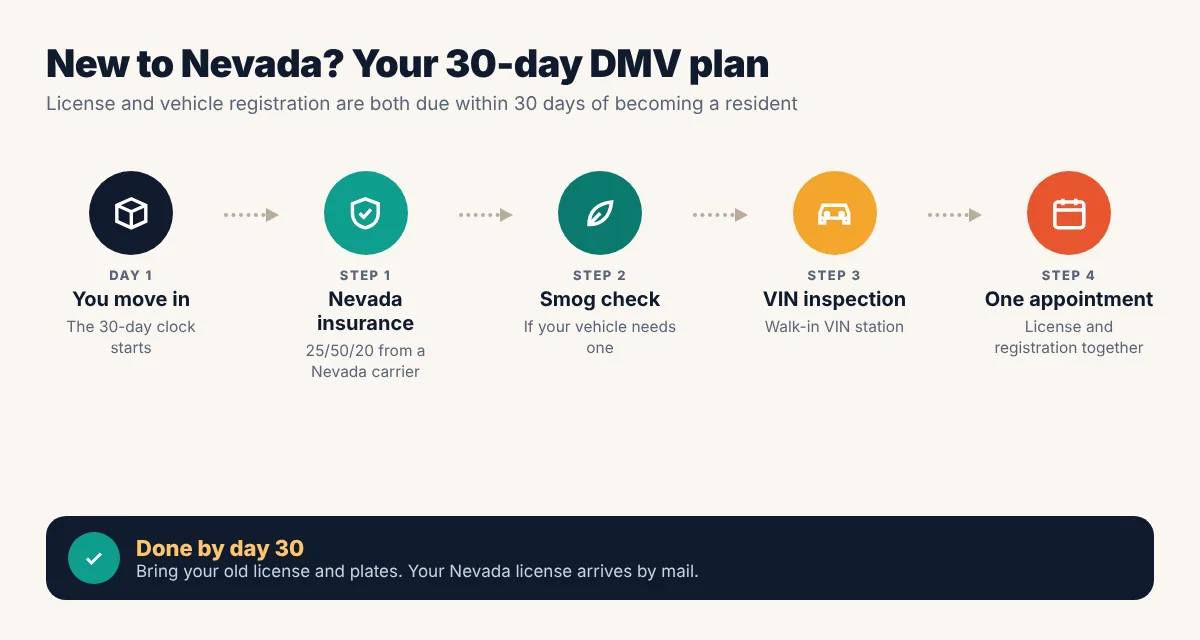
Your 30-day plan, in the right order
Do these in order and you can finish everything in a single appointment.
- Step 1Get Nevada insurance
Out-of-state policies aren’t accepted. Minimum coverage is 25/50/20 from a Nevada-licensed carrier.
- Step 2Pass a smog check
Most 1968-and-newer gas and diesel vehicles in Las Vegas need one, at a licensed emissions station. See our smog check Las Vegas guide.
- Step 3Get a VIN inspection
Walk in to the VIN station outside a metro office before your appointment.
- Step 4Book one appointment
License and registration are handled in the same visit.
- Step 5Bring it all, plates too
You leave with an interim document. Your license arrives by mail.
Transferring your out-of-state driver’s license
Bring your current license along with proof of identity, your Social Security number and two proofs of your Nevada address. These are the same documents a Real ID needs, so use our Real ID checklist to gather them and get the gold star in the same visit.
What to bring for the license
- Your current out-of-state license, permit or ID card
- 1 proof of identity and proof of any name changes
- 1 proof of your Social Security number
- 2 proofs of your Nevada home address
- Veterans: a DD-214 or other proof of honorable discharge
Will you have to test?
Nevada transfers most motorcycle endorsements from other states; our Nevada motorcycle license guide covers Class M rules and fees. If you do need a road test, see our Las Vegas drive test guide. When it’s time, most drivers can renew a Nevada license online. Moving here with a commercial license? CDLs transfer at a CDL office, not a regular counter; see our Nevada CDL guide.
Registering your out-of-state vehicle
To register, bring Nevada insurance, a smog report if your vehicle needs one, the VIN inspection, your current registration, the odometer reading, and your out-of-state license plates.
Registration checklist
- Nevada evidence of insurance
- Nevada emissions report, if required
- VIN inspection (form VP 015)
- Your current out-of-state registration
- Current odometer reading
- Your out-of-state license plates, which you trade in for Nevada license plates
- Form VP 222 if someone else registers it for you
Smog check before you register
Most gas and diesel vehicles from 1968 and newer that are based in the Las Vegas Valley need a passing Nevada emissions test. New vehicles, newer hybrids, electric vehicles and motorcycles are among the exemptions.
An emissions report is good for 90 days, so time it close to your appointment. Our smog check Las Vegas guide has the full exemption list, the 2026 test fees and what to do if your car fails.
About your title: Nevada issues a Nevada title unless a lienholder holds it. You don’t have to surrender your out-of-state title, but if it’s lost, get a duplicate from your old state first. New residents can also start the title online with Turbo Titles. Estimate your fees ahead of time with your VIN and MSRP using the DMV’s online fee estimator. Title fees and forms are in our Nevada title transfer guide.
The VIN station is a walk-in service. See our walk-in DMV guide for where to go. Only registering the car, with no change of owner? Once the VIN inspection is done, AAA branches with DMV counters can transfer an out-of-state registration; see AAA DMV services in Las Vegas. Your license transfer still needs a DMV office. Once you’re registered, you’ll renew every year; see how to renew your Nevada registration.
New Nevada resident FAQ
How long do I have to get a Nevada driver’s license after moving?
30 days. Nevada law (NRS 483.245) says a new resident must get a Nevada driver’s license within 30 days, and the DMV says your vehicle registration is due in the same 30-day window.
Do I have to take a test to transfer my license to Nevada?
Usually not, if you’re 21 or older with a valid U.S., U.S. territory or Canadian license. You will take the knowledge test if your license has been expired for more than a year, you have 3 or more moving violations in 4 years, a suspension in 4 years, a DUI in 7 years, or you’re changing license class. Drivers with a license from another country take both the knowledge and skills tests.
How much does it cost to transfer a driver’s license to Nevada?
The DMV lists $41.50 for a standard 8-year license and $17.50 for a 4-year license for drivers 65 and older. Transferring a motorcycle endorsement adds $5, and knowledge and skills testing, if required, is $25.
Can I do my license and registration at the same appointment?
Yes. The DMV processes non-commercial license and registration transactions in a single visit. Bring every document for both, plus your out-of-state license plates.
Can I use my out-of-state car insurance in Nevada?
No. Nevada doesn’t accept out-of-state insurance. You need a policy from a Nevada-licensed carrier with at least 25/50/20 coverage before you register.
Where do I get a VIN inspection as a new Las Vegas resident?
At the walk-in VIN station outside a Las Vegas metro DMV office, before your registration appointment. Our VIN inspection guide lists every station and what to bring.
Do I need a smog check to register my car in Las Vegas?
Usually, yes: most 1968-and-newer gas and diesel vehicles based in the Las Vegas Valley need a passing Nevada test before you register. Check your vehicle in our smog check Las Vegas guide.
Do military members or students have to get a Nevada license?
No. Active-duty military members and their spouses or dependents, out-of-state students, and people living in Nevada temporarily don’t have to transfer their license.