Nevada Title Transfer: Steps, Fees and Documents
A Nevada title transfer starts when the seller signs the title over and the buyer brings it, Nevada insurance and any required smog check to the DMV within 30 days. The change of ownership fee is $28.50, there’s no sales tax on a private sale, and you can start the title online with Turbo Titles.
Written by the DMV Appointment Las Vegas team · Verified by Ryan Parker & Ethan Miller · Last updated: November 2026
Your title transfer checklist
Pick your situation to get the exact documents, the fee, the deadline and whether you can start online. Tick items off as you gather them.
Loading your checklist…
Book a title appointment or start online
A title transfer at a Las Vegas DMV office needs an appointment, booked free on the DMV’s WaitWell scheduler. If you qualify for Turbo Titles, you can apply and pay online first, then drop the documents off at an office without booking a counter appointment.
Book, view, reschedule or cancel
Pick how you want to do the title, then an office. Each button opens an official DMV page.
Look up any Las Vegas DMV appointment with “Find Appointment” on the official appointments page.
West Flamingo DMV
8250 W. Flamingo Rd., Las Vegas, NV 89147 · Mon–Fri 8–5, Sat 8–4
All official booking links
- East Sahara: general appointment
- West Flamingo: general appointment
- North Decatur: general appointment
- Silverado Ranch: general appointment
- Turbo Titles online application
- All offices on dmv.nv.gov
How do you transfer a car title in Nevada?
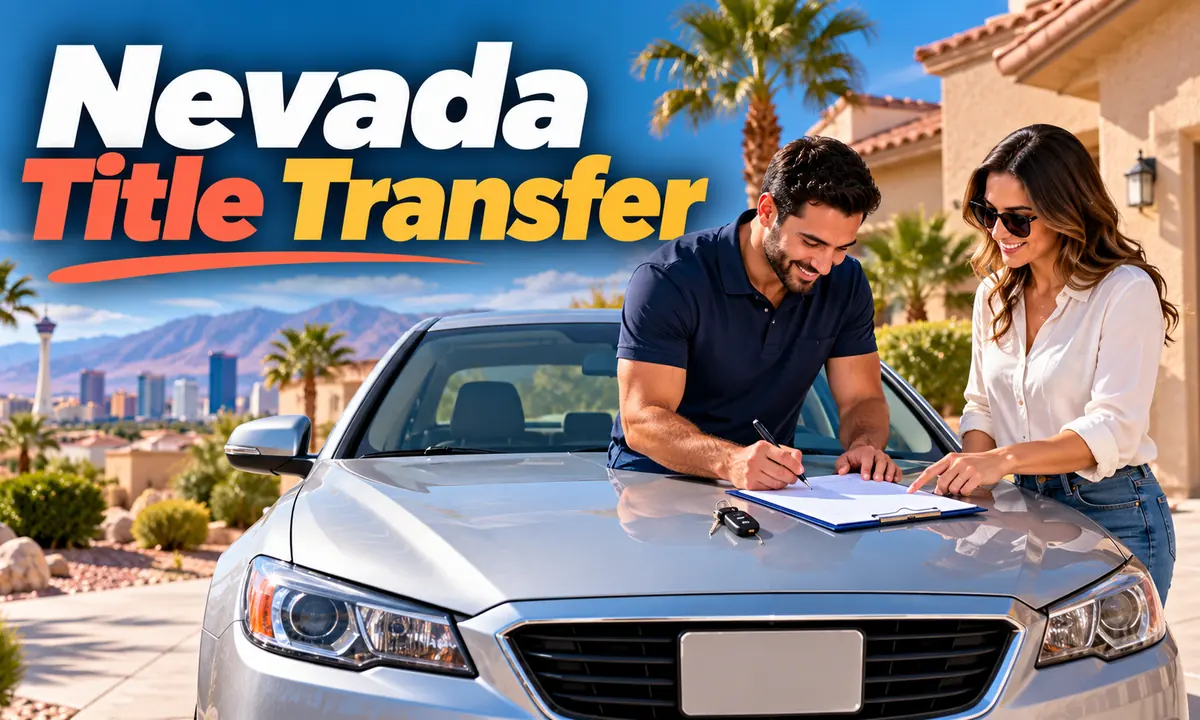
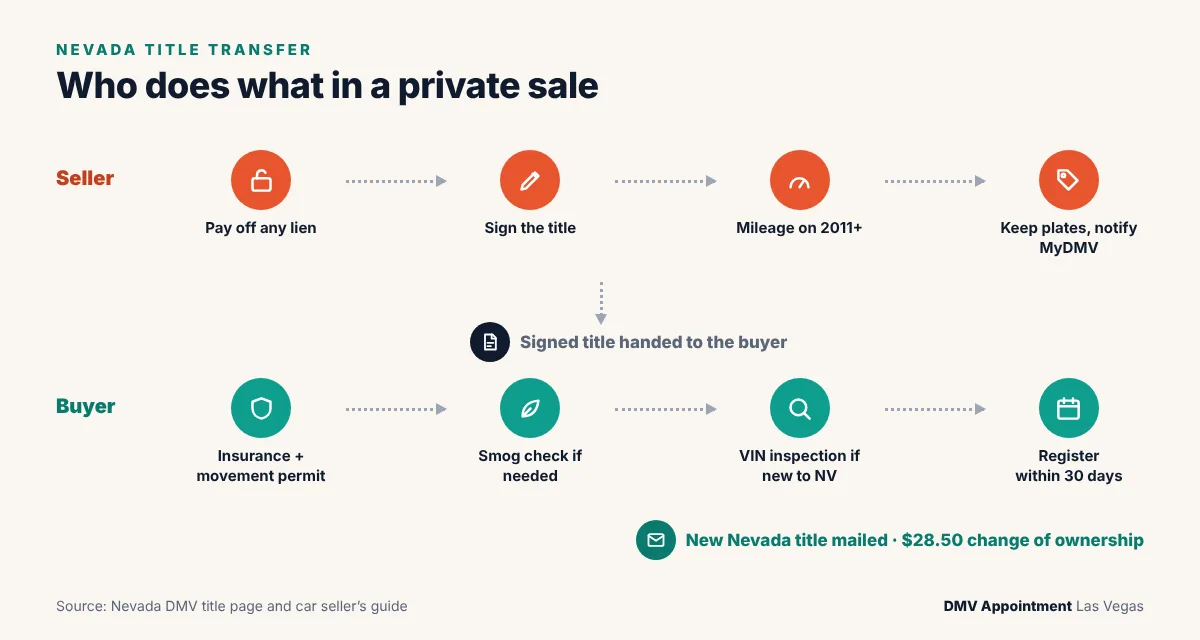
The seller signs the title and records the mileage, then hands it to the buyer. The buyer gets Nevada insurance and a movement permit before driving, passes a smog check if needed, and registers the car at the DMV within 30 days. The new title arrives by mail.
The seller
- Pays off any loan so the title is free of liens.
- Signs the title exactly as their name appears on it.
- Writes the current mileage on the title for 2011 and newer models.
- Fills in a Bill of Sale (VP 104) and keeps a copy.
- Keeps the license plates and files the registration cancellation and resale notice on MyDMV.
The buyer
- Prints their name in the buyer section exactly as it appears on their license.
- Gets Nevada insurance, plus a movement permit to drive it more than 3 days after the purchase.
- Gets a smog check if required; tests are good for 90 days.
- Gets a VIN inspection if the car has never been registered in Nevada.
- Registers at the DMV, or starts with Turbo Titles, within 30 days.
How much does a title transfer cost in Nevada?
A complete change of ownership costs $28.50 at the Nevada DMV. If you’re also registering the car, you pay the registration fee and the Governmental Services Tax on top, but Nevada doesn’t charge sales tax on a private-party sale. Lost the title first? See our Nevada duplicate title guide.
To see the full bill, including registration and tax, use the DMV’s online fee estimate with the VIN and MSRP. Registration renewals are covered in our Nevada registration renewal guide.
How do you sign over a Nevada title?
Every owner the title requires must sign in the seller section, exactly as their name is printed. If the owners are joined by “AND,” both must sign; if they’re joined by “OR,” either can sign alone. For 2011 and newer vehicles, the odometer reading must also be filled in.
JANE DOE AND JOHN DOEBoth owners must sign the title before the sale can go through.
JANE DOE OR JOHN DOEEither owner can sign the title alone.
Federal law now requires mileage disclosure until a vehicle is 20 years old, starting with 2011 models, so a 2011 car stays covered until 2031. For those vehicles the DMV won’t accept a bill of sale plus a duplicate title, several bills of sale, or a non-secure power of attorney in place of the signed paper title.
Can you transfer a title online in Nevada?
Partly. With Turbo Titles you apply for a new or duplicate title online and, since April 21, 2026, pay online too. You still drop the original title documents off at a DMV office, and the title is mailed once it’s approved.
- Apply onlineStart the new or duplicate title application on the DMV’s DriveNV portal.
- Pay onlinePay the title fees online, without visiting an office.
- Drop off documentsBring the original title documents from your application to a DMV office.
- Get your titleThe DMV mails it to the address you gave once it’s approved.
Turbo Titles works for
- Private-party, family and gift purchases
- Out-of-state dealer purchases or leases
- New residents with an existing vehicle
- Duplicate Nevada titles
- Estates, transfer-on-death and court-ordered transfers
Go to an office instead when
- You want the registration and plates done in the same visit
- You don’t have a title or other proof of ownership
- You hold a lien sale certificate, which Turbo Titles can’t take
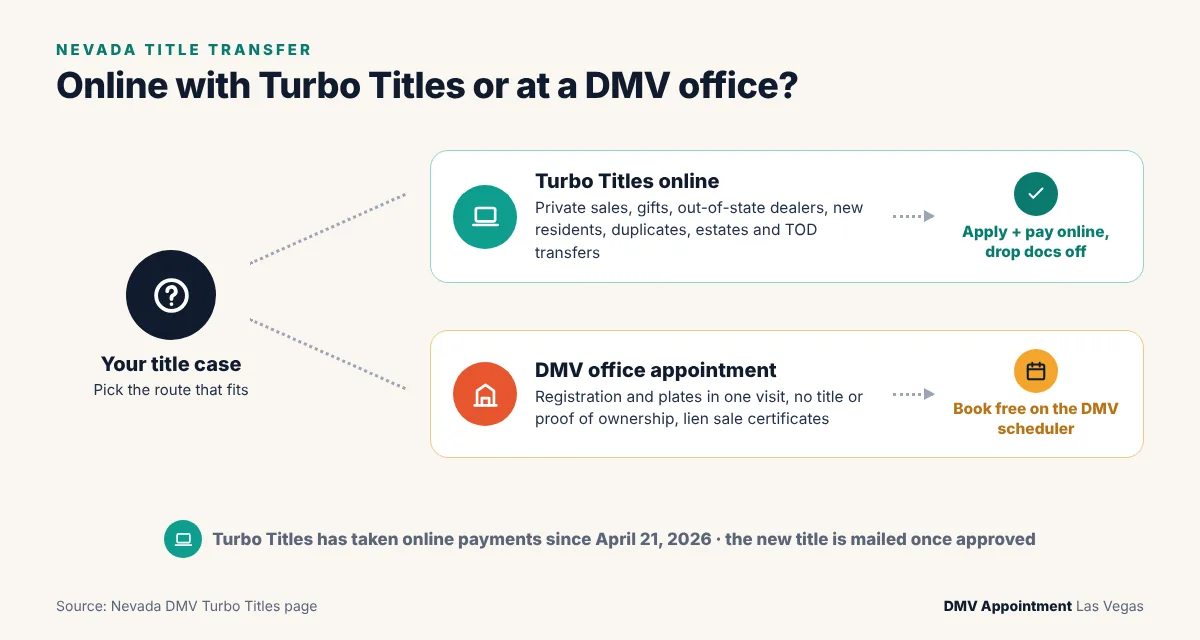
Dropping off Turbo Titles documents doesn’t need a counter appointment, as our walk-in DMV guide explains.
What should you check before you buy a used car?
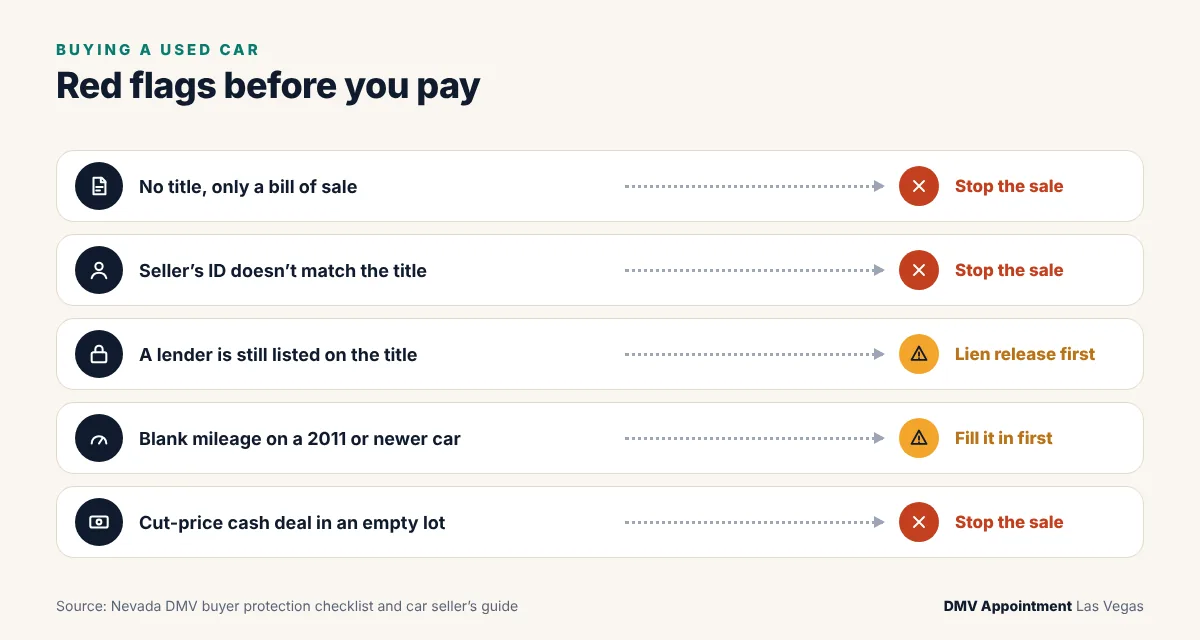
Don’t pay for a car unless the seller hands you a title in their own name. Match the seller’s ID to the name on the title, make sure no loan is still listed, and check that the seller signs in the right place and records the mileage on 2011 and newer cars.
- !“Bill of sale only”A bill of sale alone isn’t proof of ownership for registration. Walk away if there’s no title.
- !Name doesn’t matchThe seller’s ID should match the name on the front of the title.
- !A lienholder is listedA loan must be paid off and released before ownership can change.
- !Blank mileage on a 2011+ carThe odometer section must be filled in at the sale.
- !A cheap cash deal in an empty lotThe DMV recommends selling from a residence, and selling from an empty lot is usually illegal.
- !A seller flipping lots of carsSelling more than three personal vehicles a year needs a dealer license.
Want the car checked before you pay? DMV inspectors at the VIN stations can check for stolen vehicle reports and title red flags, and the DMV has suggested finishing a private sale there. See how a Las Vegas VIN inspection works, and our DMV scam alerts for other tricks to avoid.
Loan payoffs, inherited cars and lost titles
Each of these has its own paperwork. A paid-off loan needs a lien release, an inherited car usually goes through a trust, probate or the VP 024 affidavit, and a lost Nevada title is replaced with form VP 012. If you bought a car with no title, the DMV can help you find the owner or apply for a bonded title.
You paid off the loan
The lender signs the title off or gives you a lien release (VP 186). Bring that, your current registration and a smog report if needed to a DMV office, or apply for a clear duplicate title with the release. Take-over-payment deals are illegal in Nevada.
The owner has died
Vehicles usually pass through a family trust or probate; contact the DMV with the VIN to learn which papers apply. With no trust or probate, heirs can use the VP 024 affidavit. Any loan must be paid first.
The title is lost or damaged
Replace it before you sell or register the car. A Nevada title is replaced with form VP 012, and our Nevada duplicate title guide covers the fee, lien rules and online option.
You have no title at all
Bring every document you have to a DMV office for help reaching the last owner. If that fails, you may qualify for a bonded title through the DMV’s Title Research section.
Moving here with a car you already own? Your title transfer is part of registering it, covered in our new Nevada resident guide.
Nevada title transfer FAQ
How long do I have to transfer a title after buying a car in Nevada?
The DMV says a vehicle bought from a private party must be registered within 30 days of the purchase. You also need Nevada insurance and a movement permit before you drive it on public streets.
Does Nevada charge sales tax on a private car sale?
No. Nevada doesn’t charge sales tax on “occasional” private-party sales. You still pay the $28.50 title fee, registration fees and the Governmental Services Tax when you register.
Is a bill of sale enough to transfer a title in Nevada?
No. The DMV says a bill of sale by itself isn’t acceptable proof of ownership for registration; you need the signed title. See our Nevada bill of sale guide for form VP 104.
What happens to the license plates when I sell my car?
The seller keeps them. Remove them before the buyer drives away. Our Nevada license plates guide covers moving them to another car or surrendering them.
What if the seller lost the title?
The seller has to replace it before the sale. A bill of sale alone isn’t proof of ownership, so wait until the seller has a duplicate title in their name, then have them sign it over to you.
Can I transfer a title if there’s still a loan on the car?
Only with the lender’s approval. The lienholder applies for the new title and gives you a letter with the VIN, or you pay off the loan first. Subleasing and take-over-payment arrangements are illegal in Nevada.