Spot Las Vegas DMV Scams Before You Pay: Fake Sites, Texts and Sellers
Fake DMV websites, toll texts and social media “license sellers” are all targeting Nevadans. The real DMV never charges for an appointment and never sends texts you didn’t ask for. Check a link or a message below, then see what to do if you already shared your details.
Written by the DMV Appointment Las Vegas team · Verified by Ryan Parker & Ethan Miller · Last updated: October 2026
The DMV says it never charges booking fees. Anyone asking you to pay to book is not the DMV.
Check a DMV link or message
The official website is dmv.nv.gov. Only government agencies can register a .gov address, so a look-alike site can copy the design but not the address.
We check the address only. Nothing you type is sent anywhere.
Nothing ticked yet.
The DMV’s own booking pages run on WaitWell, a scheduler it links from dmv.nv.gov/appointments.htm. The safest habit is to start there, or from the official links in our Las Vegas DMV appointment guide, rather than from a search ad or a link in a message.
DMV scams the Nevada DMV has warned about
These are the scams the DMV has publicly flagged, newest first. Each one leans on the same tricks: urgency, threats, and a link or payment method the DMV would never use.
- March 2026 · Text messageFake “final collection notice”
A text claiming to be a court-ordered collection notice from a “Department of Safety & Homeland Security,” threatening license suspension, registration holds or legal action unless you pay.
The DMV says it doesn’t ask for payment this way and sends official mail when action is needed.
- December 2025 · Social mediaFacebook “license sellers”
Businesses claim they can produce a Nevada driver’s license for a fee. One customer paid over $800, was told to pay another $800 “required by the Supreme Court,” and never got a license.
Licenses only come through the DMV, and courts don’t charge fees to issue them.
- November 2025 · WebsiteLook-alike DMV sites with a chatbot
A fake site copied the DMV’s look, and a chatbot posing as an employee “booked” an appointment, then asked for a license number, Social Security number and an appointment fee.
The DMV never charges booking fees. Check that the address ends in .gov.
- April 2025 · Text messageToll and E-ZPass fines
Texts that look like they’re from the DMV demand payment for “toll” fines by a deadline, with a payment link.
Nevada has no tolls on its public roads, so any toll demand is fake.
- November 2021 · Text message“Update your MyDMV profile”
A text links to a fake MyDMV login page. The DMV says it won’t ask you to update your MyDMV account by text, and most personal changes, like a name change, are made in person. See how to spot the real MyDMV login.
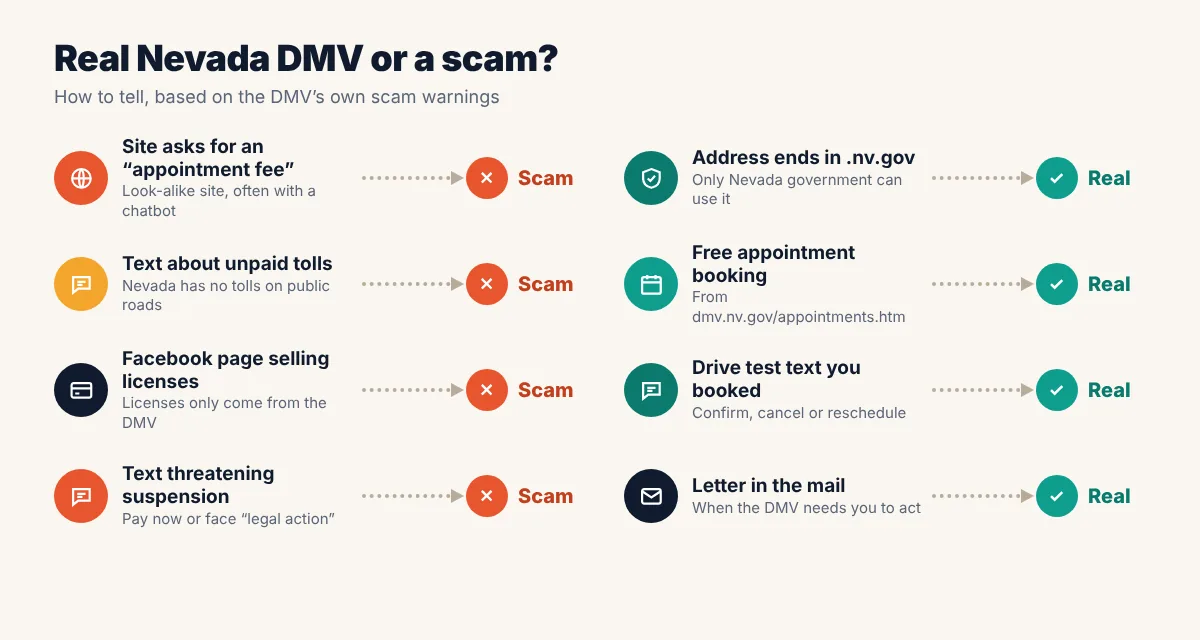
What the real Nevada DMV does, and never does
The real DMV
- Books appointments for free on dmv.nv.gov and its WaitWell pages
- Texts drive test confirmations, but only after you book a test
- Sends official mail when you need to take action
- Issues licenses and IDs only through its own offices and online services
The DMV never
- Charges a booking or “appointment hold” fee
- Sends texts or emails you didn’t ask for
- Asks for payment through social media, gift cards, wire transfers or messaging apps
- Asks you to update your MyDMV account through a text link
- Collects tolls, since Nevada has none
Buying a used car from a private seller? That’s a different kind of risk. Check the seller’s name against the title and compare the VIN on the car with the VIN on the paperwork before you pay. Our Nevada title transfer guide lists the warning signs, and the VIN inspection guide shows where to find the VIN on a vehicle.
Already clicked, paid or shared your details?
Act quickly. The DMV recommends watching your accounts and checking your credit, then reporting the scam so others don’t get caught.
- Watch your accounts
Check your bank and card activity often, and call your bank about any charge you don’t recognize.
- Check your credit
Pull your free credit reports and dispute any inquiry or account you didn’t open.
- Report it
File with the FTC at reportfraud.ftc.gov with the sender’s number and link. Lost money? Tell local police and the DMV’s Compliance Enforcement Division.
For texts, also forward them to your phone carrier’s spam reporting. Then book your real appointment the safe way: see the walk-in and same-day DMV guide if you need a slot soon.
Las Vegas DMV scam FAQ
Is a website that charges an “appointment fee” the real DMV?
No. The Nevada DMV says it never charges booking fees, so any site asking for one isn’t the DMV. In November 2025 the DMV warned about a look-alike site whose chatbot collected a resident’s license and Social Security numbers for a fake booking.
Does the Nevada DMV send text messages?
The DMV says it never sends unsolicited texts or emails. The exception is something you started yourself: drive test confirmations come by text after you book one. A surprise text about fines, tolls or your account is a scam.
Is the Nevada DMV toll text real?
No. Nevada has no tolls on its public roads, so a text asking you to pay toll fines is a scam. Don’t click the link or reply.
How do I know if a DMV website is real?
The official site is dmv.nv.gov. Only government agencies can register a .gov address. The DMV’s own appointment pages are on WaitWell and are reached from dmv.nv.gov/appointments.htm, so start there instead of from a search ad or a link in a message.
Can someone on Facebook get me a Nevada driver’s license?
No. Licenses and ID cards only come through official DMV channels. In December 2025 the DMV warned that one customer lost over $800 to a social media seller and was then asked for $800 more. Courts don’t charge fees for issuing licenses.
What should I do if I gave a fake DMV site my information?
Check your bank and card activity often, pull your free credit reports and dispute anything you don’t recognize. Report the scam to the FTC at reportfraud.ftc.gov, and if you lost money, to local law enforcement and the DMV’s Compliance Enforcement Division.
Where do I report a DMV scam in Nevada?
Report it to the Federal Trade Commission at reportfraud.ftc.gov, including the number the text came from and any link it had. You can also report it to the DMV through its online form, to local police, and, for texts, through your phone carrier’s spam reporting.